Experts Claim Bath & Body Works’ Candles Release Toxic Chemicals—Is It True?

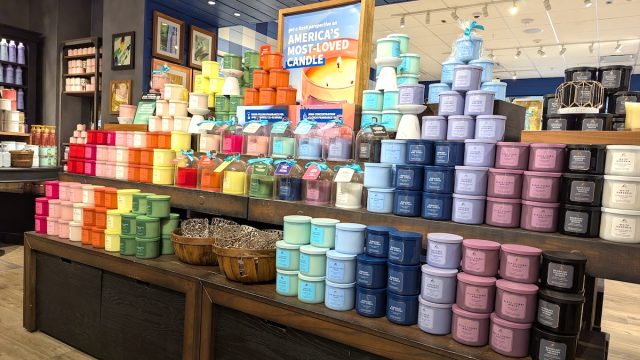
Bath & Body Works’ candles are my weakness. From the soothing aroma of lavender to the crisp scent of balsam fir at Christmastime, I have a Bath & Body Works candle burning in my home at any given moment. However, recent accusations about their candles’ ingredients have me reevaluating my collection—so, let’s break it down.
RELATED: Doctors Say the Dryer Sheets You’re Using Contain Hidden “Toxic” Chemicals.
Some say Bath & Body Works candles are made from cancer-causing ingredients.
Bath & Body Works candles are made from a blend of paraffin wax, soybean wax, and palm oil. (A full list can be found on a candle’s product page by clicking the “Ingredients” toggle, located under the “Usage” tab.)
When burned, paraffin wax can pose a significant threat to the environment and release potentially harmful volatile organic compounds (VOCs)—some of which are known carcinogens, including acetone, benzene, and toluene. According to the Women’s Health Network, “Exposure to these harmful toxins can trigger headaches; eye, nose and throat irritation; allergies; and even asthma attacks.”
The International Agency for Research on Cancer (IARC), an umbrella of the World Health Organization (WHO), has identified benzene as “carcinogenic to humans” following “sufficient evidence” that it increases the risk of leukemia and non-Hodgkin lymphoma, per the American Cancer Society (ACS). The U.S. National Toxicology Program (NTP) and U.S. Environmental Protection Agency (EPA) have also dubbed it “a human carcinogen.”
Toluene has been associated with neurological issues and reproductive system damage, per the U.S. Department of Labor Occupational Safety and Health Administration (OSHA).
Comparatively, organic candles use coconut oil or beeswax instead. The latter is soot-free and doubles as a natural air purifier, too. “When burned, beeswax candles produce negative ions which bind with air pollutants (positive ions) and drop to the floor, removing them from the air and leaving it cleaner,” explains homemaking blog The Home Intent.
Bath & Body Works candles are also pumped with synthetic fragrances.
I’ll be the first to admit that I’m a little naive when it comes to sussing out natural fragrances from synthetic ones. Case in point, if a candle says it’s made with essential oils, I usually take it at face value. However, going down this natural vs. synthetic perfume rabbit hole has been a wake-up call.
It turns out the word “fragrance” is often used to generalize a group of different chemicals. Moreover, there are no mandates in place that require manufacturers to list these chemicals. Thus, companies can get by using the term “fragrance” or “parfum.”
As Better Goods explains, “The big problem with fragrance is that it’s a catch-all term that can contain any number of mystery ingredients. Any time you see ‘fragrance’ or ‘parfum’ on a label, that means it’s being used to hide the actual chemical makeup of the fragrance.”
Previous research has linked synthetic fragrances in personal care and household products to headaches, asthma attacks, cardiovascular issues, breathing difficulties, neurological conditions, and allergic reactions.
RELATED: Pharmacist Warns Never Buy These 4 Health Items From Costco: “Toxic to Your Microbiome.”
However, some experts believe Bath & Body Works’ candles are still safe to burn.
Although health agencies advise against the use of paraffin wax candles and synthetic fragrances in general, other toxicology experts argue that Bath & Body Works’ candles are perfectly safe.
Exposure to VOCs and other toxic ingredients “is so low that they pose no significant risk to human health,” Nikaeta Sadekar, a respiratory toxicologist with the nonprofit Research Institute for Fragrance Materials, told The New York Times. “Even the highest users of scented candles and other fragranced products are not putting themselves at any appreciable risk of harm.”
Pamela Dalton, an odor perception and irritation researcher at the Monell Chemical Senses Center in Philadelphia, noted that these chemicals are emitted in “relatively trivial concentrations.”
What has Bath & Body Works said about their candles?
Despite this controversy, Bath & Body Works remains steadfast in their candles’ safety and craftsmanship.
“As more than a decade of rigorous testing has shown, our candles are safe! They undergo extensive quality and safety testing under rigorous burn and use conditions and meet or exceed all applicable industry and government standards for safety and performance. There are many factors while in use that can affect any candle’s performance, including: room drafts, debris that may have accumulated in the wax’s melt pool, wick length and proper pre‐burn trimming which is included on the instructions on the candle label,” the company wrote in a product safety statement.
Additionally, Bath & Body Works has maintenance tips for before, during, and after use available online.