10 Best Exercises That Improve Your Joint Health

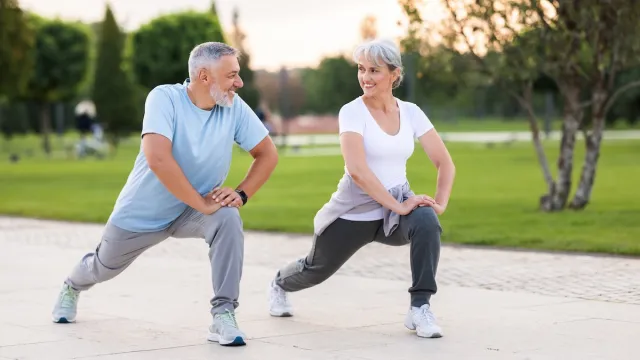
As you age, maintaining your joint health is essential to your mobility and overall well-being. After all, having painful, stiff, or swollen joints can prevent you from partaking in physical activity that ultimately helps to stave off disease and disability.
However, fitness experts suggest that a handful of specific exercises can improve joint health and help prevent joint problems, including osteoarthritis, rheumatoid arthritis, bursitis, and others. Many of these exercises are also low-impact, helping you avoid joint and muscle injury in the process.
If you’re not sure where to start, you’re not alone—many people don’t think about their joint health until they’re faced with a particular problem. That said, it’s never too early to begin. Read on to learn 10 simple exercises that will keep your joints healthy, allowing you to stay active well into your senior years.
RELATED: 7 Best Exercises to Improve Your Balance.
1
Swimming

Swimming is an ideal form of exercise to enhance joint mobility without excessive impact. In fact, a 2016 study published in The Journal of Rheumatology found that regular swimming reduced joint pain and stiffness associated with osteoarthritis (OA), which most commonly affects the hands, hips, and knees.
Swimming also “improved muscle strength and functional capacity in middle-aged and older adults with OA,” the study authors wrote.
“Swimming is a fantastic low-impact exercise that provides a full-body workout while being gentle on your joints,” says Chrissy Arsenault, MBA, RDN, a sports nutritionist and personal trainer with Athletic Muscle. “The buoyancy of water reduces the impact on joints, making it an excellent option for people with joint pain or arthritis. It helps improve joint flexibility, muscle strength, and cardiovascular fitness.”
2
Aquarobics

Adding weights to your pool routine can further ramp up the benefits. Aquatic exercise, also known as “aquarobics,” is ideal for anyone dealing with joint pain—or, in fact, for anyone who wants to focus on low-impact exercise.
“Exercise in the water removes the impact stress of ground reaction force,” Lauren Shroyer, MS, tells CreakyJoints.org. “When joints are inflamed and painful during weight-bearing exercise, working out in the water allows you to experience the advantages of movement without the negative consequence of impact.”
Water puts more resistance on muscles, which helps them grow stronger and lessen joint pain, while also improving mobility and cardiovascular health.
“It allows you to perform movement with an arthritic joint that would be painful on land, which then helps improve strength and flexibility in that joint,” says Julie Mulcahy, DPT. “Patients with chronic joint conditions often say they feel free from their disability when in the water.”
3
Cycling

The Journal of Rheumatology study also found that cycling was an effective exercise for improving joint health, with benefits on par with those of swimming.
“After the exercise interventions [swimming and cycling], there were significant reductions in joint pain, stiffness, and physical limitation accompanied by increases in quality of life in both groups,” the study authors wrote. In fact, they noted that functional capacity “as assessed by maximal handgrip strength, isokinetic knee extension, and flexion power” increased by 15-30 percent after regular cycling.
Arsenault agrees that cycling helps increase joint mobility and strengthens the muscles around the joints, providing better support. “Whether on a stationary bike or outdoors, cycling can be a great way to improve joint health while getting your heart rate up,” she tells Best Life.
RELATED: 9 Best Fitness Classes to Take If You’re Over 60.
4
Tai chi

According to the Osteoarthritis Foundation International, “practicing Tai Chi not only improves discomfort in people affected by arthritis, osteoarthritis or any other pathology that causes joint pain, but it also helps prevent and delay its appearance in healthy people.”
Arsenault agrees that Tai Chi is especially beneficial for joint health because its slow, controlled motions help lubricate the joints and improve their range of motion. “This ancient Chinese practice combines gentle, flowing movements and deep breathing,” she explains. “It enhances balance, flexibility, and muscle strength, while also promoting relaxation and reducing stress.”
5
Circle stretches

Stretching is also essential to your joint health. In particular, Andrew White, CPT, a personal trainer and the founder of Garage Gym Pro, says that doing circle stretches, including ankle circles, arm circles, and hip circles, can increase your range of motion, direct blood flow to the joints, boost mobility, and enhance flexibility.
White recommends rotating each joint clockwise for 10 circles, then rotating counter-clockwise for another 10 circles: “As a personal trainer, I’ve seen many clients benefit immensely from these simple movements.”
6
Resistance training

Many people assume that resistance training with weights or bands will lead to wear and tear on the joints. However, studies show that the opposite is true: Done properly, resistance workouts can improve joint health.
“Using resistance bands or light weights in controlled movements can help strengthen the muscles surrounding your joints. This added muscle support can relieve stress on the joints and improve stability. Be sure to start with low resistance and focus on proper form to avoid straining your joints,” says Arsenault.
However, there’s one exception to the rule. According to Harvard Health Publishing, it’s best to avoid resistance training if you have actively inflamed joints.
RELATED: If You Can Balance on One Leg for This Long, You’re in Great Shape, Doctors Say.
7
Targeted calisthenic exercises

Calisthenic exercises that use your own body weight can benefit your joint health. Specifically, White recommends trying leg extensions, which can strengthen the leg muscles and improve the range of motion in your hips, knees, and ankles.
“Sitting in a chair, extend one leg out in front of you as straight as possible and then flex it back down. Repeat for 10 reps and then switch legs,” he says. “This promotes strength and flexibility in the knee joint. As someone who’s always been an avid runner, this exercise has been crucial for keeping my knees in optimal condition.”
Lunges are another simple calisthenic exercise that can improve joint mobility and strength. “They are a great exercise for your lower body muscles, but they can be hard to do at first. You can practice them slowly and with someone’s help if you need to,” says Robert Pustowar, a fitness expert and founder of Home Athlete Zone.
8
Yoga
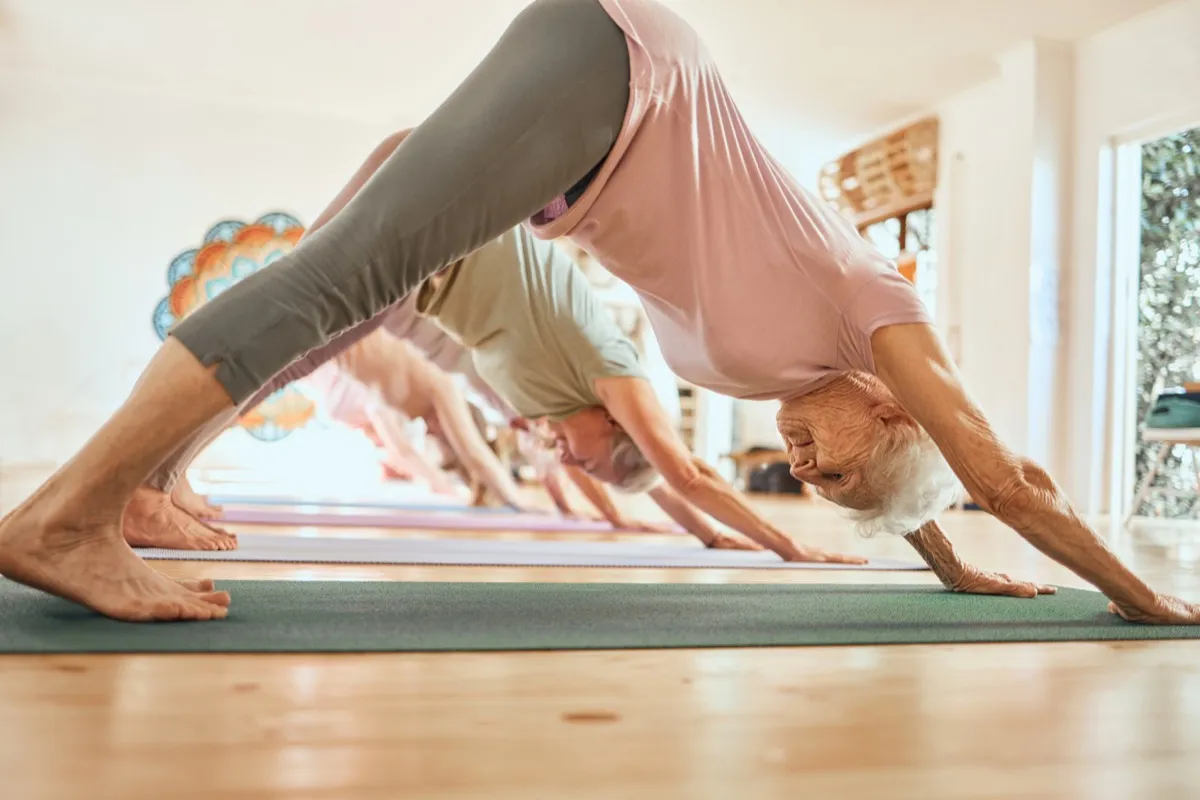
Jean Christophe Gabler, founder of YOGI TIMES, says that many yoga poses are proven to be beneficial for joint health. In particular, he recommends downward-facing dog, also known as Adho Mukha Svanasana.
“It is used in many yoga bases, and it is the foundational pose for many other yoga sequences,” Gabler tells Best Life. “In this exercise, stand in the position of legs being hips apart, your hand and fingers aligned with your shoulder. Bend your knees and put your palms on the floor with your fingers spread apart. Forming an inverted V position, this position helps to strengthen the shoulder and wrist joints.”
9
Walking

Research shows that walking is protective against joint problems, especially knee pain.
In fact, a 2022 study published in the journal Arthritis & Rheumatology analyzed the walking habits of over 1,200 people and found that out of the individuals who did not report having knee pain, those who walked regularly were less likely to develop knee pain over the following eight years.
Among the study subjects who did report having knee pain at the outset of the study, those who walked regularly tended to have less severe structural damage to the knees compared with non-walkers.
RELATED: 6 Best Walking Workouts for Weight Loss.
10
Any exercise that helps you lose weight

While it’s important to choose exercises that are gentle on the joints, experts emphasize that any workout that helps you lose weight could lead to improvements in your pain.
“The joints most prone to pain are the joints that bear weight or are constantly in use even when we’re unaware of it,” Brynna Connor, MD, tells First For Women. “The weight-bearing joints prone to pain include the knees and the hips, while joints prone to overuse injuries are in the hands and the wrists. Shoulders are also prone to pain due to their movement patterns, potential rotator cuff problems, a lack of substantial muscular training and support or stability around the joint.”
One 68-week study from Novo Nordisk highlights the potential joint benefits of weight loss. It found that individuals living with both obesity and knee osteoarthritis who lost significant amounts of weight using GLP-1 weight loss drugs saw a 50 percent reduction in their knee pain.
“The key to a successful exercise program is variety. Completing a balance of aerobic, muscle-strengthening, and flexibility exercises, along with keeping a healthy weight, will provide the base for good joint health for a lifetime,” Gary Calabrese, PT, DPT, tells Cleveland Clinic.
- Source: The Journal of Rheumatology: Improved Function and Reduced Pain after Swimming and Cycling Training in Patients with Osteoarthritis
- Source: Harvard Health Publishing: 5 weight training tips for people with arthritis
- Source: Arthritis & Rheumatology: Association Between Walking for Exercise and Symptomatic and Structural Progression in Individuals With Knee Osteoarthritis
- Source: The New England Journal of Medicine: Once-Weekly Semaglutide in Persons with Obesity and Knee Osteoarthritis