3 Simple Design Tricks That Instantly Make Any Room Look Bigger


Even the most stylish homes can fall victim to sneaky design snafus. For instance, choices like your wall colors and furniture placement can visually shrink a room and throw off the balance of your space. But to help your home feel brighter, airier, and more spacious, an interior designer shares the most common mistakes he sees—and how to fix them fast with these design tricks to make any room look bigger.
RELATED: 8 Paint Colors That Will Make Any Small Room Feel Instantly Bigger.
1. Choose a four-color scheme.
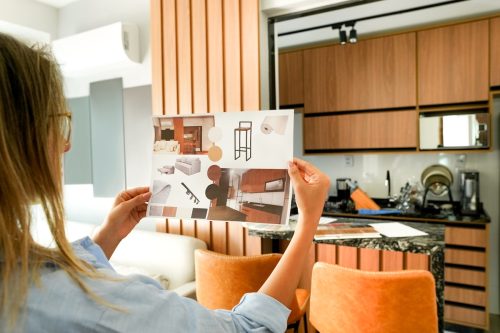
In a TikTok video, Toronto-based interior designer Phoenix Grey, founder of Phoenix Grey Design, explains that “having a claustrophobic color palette” is the first mistake that can make your home look and feel smaller and cramped.
“Having too many colors makes the space feel like it’s busier than it needs to be, therefore, making it appear smaller,” he says.
His rule of thumb is to choose a color palette with three to four complementary colors. Interior design service The Havenly seconds this advice, and recommends combos such as:
- Soft gray, muted sage, pale blue, and golden orange
- Black, ivory, muted gray, and warm tan
- Plum purple, mauve pink, olive green, and warm brown
Also, be aware of how many patterns you’re using in a room. Even if they’re within your color scheme, too many patterns can have a similar claustrophobic effect. “If there’s too many competing features, it brings in the room instead of expanding it,” Grey notes.
RELATED: 10 Home Design Trends That Make Your House Look Dated.
2. Don’t neglect vertical space.

Even if a room is small by square footage, you can make it look larger by drawing the eye upwards and making the space feel taller and less closed in, says Grey. To do this, he suggests incorporating some of these lengthening elements:
- A tall, skinny, mirror
- A high bookcase
- A slim piece of artwork
- Long curtains
- A statement, standing lamp
“Accentuate those wall spaces that have nothing on them, that really direct your eyes to look up,” he recommends.
RELATED: Interior Designer Reveals the No. 1 Thing Making Your House Look Cheap.
3. Choose an anchor point.
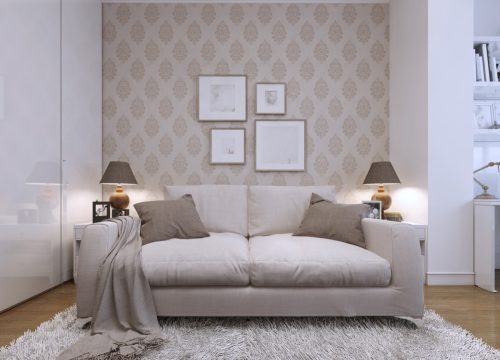
“This is the biggest mistake that I see a lot of people do not have,” shares Grey, speaking about leaving out an anchor point in a room.
“If your eyes don’t have somewhere to rest in a space, you are constantly looking around, and it doesn’t feel at ease,” he explains. “And if it doesn’t feel at ease, this, in essence, makes it visually busy.”
So, what is an achor point? It can be a piece of furniture, a chandelier, an accent wall, an architectural feature such as a fireplace, or a prominent piece of artwork—basically anything that immediately attracts attention in the space without feeling overpowering.