Doctors Share 8 Ways You’re Silently Damaging Your Kidneys

Your kidneys serve several important functions in the body. Not only do they work hard to remove fluid and waste from over 200 quarts of your blood per day, but they also produce hormones that help control your blood pressure, keep your bones healthy, control pH levels, and produce red blood cells.
“They [also] play a vital role in water balance, and regulate the levels of important minerals in our body like sodium, potassium, and calcium,” says nephrologist Kalyani Perumal, MD, medical director of dialysis at the Renal Diseases Department at Cook County Health.
Perumal points out that kidney disease is one of the fastest-growing epidemics in the U.S., with one in three adults at risk of developing the condition.
“About 37 million American adults have kidney disease, and most are unaware of it,” she says. “Kidney disease is often referred to as a ‘silent killer,’ as many do not have any symptoms until it has reached late stages.”
Yet despite being an essential organ, many of us put our kidneys through the wringer on a daily basis. That’s why we reached out to doctors to learn more about the dos and don’ts of kidney health. Read on to learn the eight ways you’re silently damaging your kidneys.
RELATED: The No. 1 Supplement Causing Dangerous Liver Damage, Doctors Warn.
1
Drinking diet soda

According to the Mayo Clinic, artificial sweeteners can be safe for healthy adults to consume in moderation. However, “some research on long-term, daily use of artificial sweeteners suggests a link to a higher risk of stroke, heart disease and death overall,” their experts acknowledge.
One study suggests that diet soda made with artificial sweeteners may also hinder your kidney health.
“A number of years ago, it was reported in an 11-year research study done by Harvard Medical School of more than 3,000 women that diet soda was associated with a doubled increase in declining kidney health,” says S. Adam Ramin, MD, a urologist and medical director of Urology Cancer Specialists in Los Angeles, California, noting that the same results were not replicated in a study of sugar-sweetened soft drinks.
This led the researchers to conclude that the negative effects on the kidneys are associated with the artificial sweeteners found in these beverages.
“My advice: stick to water,” urges the urologist. “It has zero calories and is so much better for nearly every organ system in your body, including your kidneys.”
2
Having too much caffeine

“Because caffeine is a stimulant, too much of it can increase blood pressure, which increases stress on the kidneys and makes them go into ‘overdrive,'” Ramin explains, adding that the long-term effects of this can include kidney failure.
“Avoid the risk by reducing your intake to no more than one or two daily cups of coffee,” he says. However, if you have a known kidney condition, it’s best to speak with a doctor or registered dietitian about how much caffeine is safe for you.
RELATED: 3 Foods That “Destroy” Your Kidneys, Naturopathic Doctor Says.
3
Taking certain supplements

People with chronic kidney disease or a history of kidney stones should always speak with their doctor before starting any new supplement. However, a couple of supplements, in particular, could harm this vital organ.
Angela Dori, PharmD, a pharmaceutical patient consultant and medical content creator, previously told Best Life that taking “mega doses” of vitamin C can be especially harmful since “excess vitamin C is excreted as oxalate, which can form kidney stones.”
Moreover, a 2023 study concluded that a “high, toxic dose of vitamin C has been proven to cause hyperoxaluria and complications like acute kidney injury.”
Dori also pointed to calcium supplements, especially if taken with vitamin C. “Calcium is excreted through urine, and most kidney stones are composed of calcium and oxalate,” she explained.
4
Not drinking enough water

Staying hydrated helps everything from your mood and energy levels to blood pressure and heart health. It also helps your kidneys function properly.
“One common habit that can damage the kidneys is not drinking enough water,” says board-certified family physician Laura Purdy, MD. “Dehydration can lead to the buildup of toxins in the body, which can put a strain on the kidneys. It is essential to drink enough water to keep the body hydrated and help the kidneys flush out waste and toxins.”
RELATED: Eating More of This Vitamin Could Protect Against Kidney Stones, Scientists Say.
5
Eating too much salt
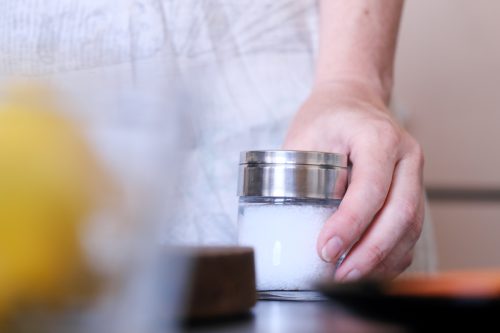
Minimizing your salt intake can have a notable impact on your kidney health, especially if you already have a known kidney problem.
According to the NKF, healthy adults can plan on consuming 2,300 mg of sodium per day, while those with kidney disease or high blood pressure should limit themselves to 1,500 mg daily.
“The problem is that when you eat too much salt, the kidneys respond by retaining water in order to dilute it,” explains Ramin. “This is a protective measure that helps balance the chemical levels of the bloodstream, which is required to keep our hearts in working order. Over time, placing this much stress on the kidneys can cause damage to them and to the heart muscle.”
6
Eating too much red meat

There is ample evidence to suggest that animal-based proteins strain the kidneys as they work to eliminate waste from the bloodstream, with red meat topping the list.
Ramin warns that, in particular, frequent consumption of red meat has been linked with an increased risk of developing kidney stones. Though undoubtedly painful, kidney stones aren’t the worst possible outcome linked with red meat-heavy diets.
A 2017 study published in the Journal of the American Society of Nephrology found that red meat intake was “strongly associated” with end-stage renal disease (ESRD) risk in a dose-dependent manner (meaning the more frequently people consumed red meat, the higher their risk became). Meanwhile, poultry, fish, eggs, and dairy products were not correlated with an increased risk of ESRD.
Both the study authors and Ramin recommend swapping out red meat for plant-based proteins whenever possible. Nuts and seeds, whole grains, beans and legumes, and high-protein vegetables such as peas and broccoli are all considered kidney-healthy options.
RELATED: How Often You Poop Could Be Hurting Your Kidneys and Liver, New Study Says.
7
Eating heavily processed foods

According to a 2022 study published in the journal Nutrition, study subjects who ate the largest amount of ultra-processed foods had the highest incidence of chronic kidney disease.
“The human body and its filtration system, including the kidneys, weren’t designed to process the ‘fast foods’ our society so readily consumes today,” Ramin tells Best Life. “Too much of these foods over too long a period effectively shuts down the way our bodies handle the waste from them.”
The urologist adds that while many health care professionals tout eating “everything in moderation,” this can be a misleading concept—especially when it comes to fast food.
“One person’s idea of moderation might be the next person’s idea of excessive. Instead, focus on incorporating or increasing a wide variety of fruits, vegetables, legumes, whole grains, and water into your diet,” he advises. “Doing so will help leave a lot less room for the foods that can ultimately ruin your kidney health.”
8
Drinking alcohol or taking painkillers too frequently

According to the NKF, drinking four alcoholic beverages daily can double your risk of chronic kidney disease. Being a smoker can compound this risk.
“Heavy drinkers who also smoke have an even higher risk of kidney problems. Smokers who are heavy drinkers have about five times the chance of developing chronic kidney disease than people who don’t smoke or drink alcohol to excess,” the organization writes.
Similarly, individuals who abuse painkillers or other drugs are at higher risk of developing kidney problems, the NKF says. This holds true for over-the-counter pain medicines, such as nonsteroidal anti-inflammatory drugs (NSAIDs) and Analgesics. “Reduce your regular use of NSAIDs and never go over the recommended dosage,” their experts urge.
- Source: https://www.mayoclinic.org/healthy-lifestyle/nutrition-and-healthy-eating/in-depth/artificial-sweeteners/art-20046936
- Source: https://www.ncbi.nlm.nih.gov/pmc/articles/PMC3022238/
- Source: Megadose Vitamin C Prescription Through Alternative Medicine Leading to End-Stage Renal Disease
- Source: https://pubmed.ncbi.nlm.nih.gov/27416946/
- Source: https://pubmed.ncbi.nlm.nih.gov/36079805/
- Source: https://www.kidney.org/content/10-common-habits-that-may-harm-your-kidneys