Flash Floods Have Increased 70% This Year—Is Your State at Risk?

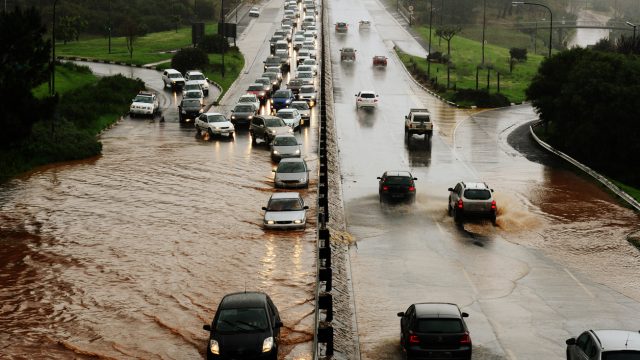
This year is poised to become “one of the most flood-impacted summers on record” in the U.S., according to a new report from AccuWeather. Flash floods are defined by the National Weather Service (NWS) as flooding that begins within three to six hours of “extremely heavy” rainfall from thunderstorms.
Destruction is influenced by a number of factors, including topography and the intensity, location, and distribution of rainfall. For instance, the NWS says urban areas are “prone to flooding in short time-spans” and will likely suffer “more severe” flooding compared to the suburbs or countryside.
RELATED: Meteorologists Warn of Above-Average Hurricane Season: “Be Prepared.”
There have already been 4,800 flash floods this year.
The Central Texas flood, which tore through Kerr County over the July 4th weekend, caused mass destruction and a significant loss of human life. The region got over 12 inches of rain, causing the Guadalupe River to swell 27 feet in less than an hour. The catastrophic event killed over 130 people—many of whom were children—and three remain missing. According to AccuWeather, this marks the Lone Star State’s second-deadliest flood event in history.
Meanwhile, flash floods have also been reported in the Carolinas, New Mexico (where homes were separated from their foundations), and New Jersey. A series of thunderstorms ripped through major cities like Chicago and New York City earlier this month. At one point, Central Park got 2.07 inches of rainfall in a single hour, “making it the second-wettest hour ever recorded in the city,” per The New York Times.
There have been 4,800 flash floods this year, thus far—and what’s even more terrifying is that hurricane season is just getting started.
“So far in 2025 across the U.S., there’s been a 70 percent increase in reports of flash flooding when you compare that to the 10-year historic average through mid-July,” said AccuWeather chief meteorologist Jon Porter. “This means that there have been more than 4,800 reports of flash flooding. That’s a huge number and why so many people feel like they’ve been hearing a lot about flash flooding in the news.”
Weather experts have noticed a shift in rainfall patterns following back-to-back years of below-average flash flooding reports. In summer 2024, flash flood reports were up 30 percent—that statistic has more than doubled in the last 12 months.
RELATED: Meteorologists Predict Wildfires Will Burn 9 Million Acres This Year.
These areas are most prone to flash flooding:
While hurricanes and blizzards are considered seasonal natural disasters, flash floods are not, meaning they can happen whenever and wherever. However, meteorologists consider summer to be the peak period due to “how the atmosphere behaves.”
“Daytime heating fuels stronger thunderstorms. Warmer air holds more moisture. Upper-level winds slow down as the jet stream shifts north. These factors combined can allow slow-moving to stalled storms to unload tremendous rainfall over the same area, more than the ground can absorb it or infrastructure can drain it,” explains AccuWeather.
This was the case for the Central Texas flash floods. Experts warn that the Ohio Valley, Midwest, and “farther south and in the Northeast” are in for a wet summer because of a “very active storm track from Canada.” This opens the doors for “ample opportunity” for severe rainfall.
Additionally, high levels of water vapor in the air mean “summer storms now carry more punch, boosting flooding potential across the country.” This is evident in forecast predictions for the South and Northeast.
“The Tennessee Valley is projected to experience a 20 to 40 percent increase in these rainfall events, and also parts of New England,” per the AccuWeather analysis.
RELATED: Meteorologist Warns This Is the No. 1 Sign a Tornado Is Brewing.
How to stay safe from flash flooding:
Although rainfall is a relatively good thing, it’s important to reiterate that flash flooding poses a serious threat to life and a city’s infrastructure. “It means that when rain does fall, it can fall fast and hard,” says AccuWeather.
In fact, Climate Central found that hourly rainfall rates have skyrocketed across nearly 90 percent of major U.S. cities in the last 50 years.
As AccuWeather explains, “These changes, combined with aging infrastructure, make fast-onset flooding more likely to cause damage, injury, and death. And while each storm has its own setup, experts agree that the atmosphere is trending wetter, the rainfall is falling harder, and the risk isn’t going away.”
Flash floods, unfortunately, occur at a moment’s notice, which is why preparation is key.
“Flash flooding can happen with little warning, and in places that aren’t used to seeing it. Know your flood risk, pay attention to alerts, and never underestimate even a short burst of heavy rain. Being weather-aware can make the difference between life and death,” advises AccuWeather experts.
The FEMA Flood Map Service Center has a free interactive map that allows people to see if they live in a designated flood zone via a simple address search.
- Source: https://www.accuweather.com/en/severe-weather/is-flash-flooding-getting-worse-summers-soaking-start-may-hold-the-answer/1796230
- Source: https://www.weather.gov/phi/FlashFloodingDefinition
- Source: https://www.climatecentral.org/climate-matters/heavier-rainfall-rates-in-us-cities
- Source: https://msc.fema.gov/portal/search