4 U.S. Regions Where Winter Storms Are Becoming More Extreme

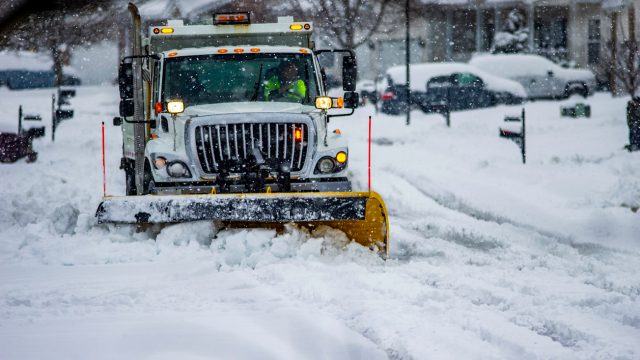
By now, it’s clear that the effects of climate change are drastically shifting the way the elements affect specific areas. For some regions, that means an increased risk of deadly flooding or an ever-shortening winter season. But on the other hand, scientists have also begun to probe how some places are experiencing much more severe winter weather in recent decades. Now, research supports the theory that some areas are seeing far worse events during the colder months than ever before. Read on to see the different regions where winter storms are becoming more extreme, according to studies.
RELATED: 4 Regions Most Likely to See Their First Snowfall in December.
1. The Pacific Coast and West
In recent years, the term “atmospheric river” has become more of a permanent fixture in news coverage. The West Coast, in particular, has suffered devastating flooding caused by powerful rainstorms that bring more precipitation in a few days than some areas will see all year.
According to researchers at Climate Signals, this has to do with rising temperatures, as warmer air can carry more moisture. Coupled with Arctic warming that shifts the jet stream and changes weather patterns, more intense winter storms in the form of torrential rains appear to be becoming more common during the most recent decades.
A recent study conducted by the Pacific Northwest National Laboratory (PNNL) looked into the rise of more extreme storms across the Pacific Coast and the American West. Using models and simulations to compare recent historical and future winters, they found that the top 20 percent of heavy storms by precipitation would see around a 40 percent increase in their output.
Ultimately, they expect storms to become wetter and affect wider areas, but will also bring more concentrated precipitation within the storm’s center.
Fortunately, these results are not set in stone: The team did clarify that their simulations used a “high-emissions scenario” in which global warming continues at its current pace. They suggest that investing in flood mitigation and improved infrastructure could help soften the blow, as well as improve forecasting and detection methods.
2. The Northeast
While some research indicates that the most sensitive regions of the Northeast may be experiencing shorter winters, the storms that occur during the season still appear to be worsening.
In a 2018 study published in the journal Nature Communications, a team of researchers looked at data from the Accumulated Winter Season Severity Index (AWSSI) collected at weather stations nationwide. The index looks at sharp cold spells, major snow events, lingering snow cover, and more to quantify brutal winter conditions.
Results showed that since 1990, the Northeast has seen more frequent heavy snowfall events than before. This is especially true in mid to late winter, when results showed that Arctic warming allowed for colder air to move further south into the U.S. (which also happens to be creating the current polar vortex).
RELATED: 4 U.S. Regions Most Likely to Have a Record-Cold December.
3. The Mid-Atlantic
It wasn’t just the Northeast that was seeing a worse side of winter: The same study also found that a “strong relationship between a warmer Arctic and increased frequency of severe winter weather is apparent for all [weather] stations east of the Rockies, with the strongest association in the eastern third of the U.S.,” the research team wrote.
In this case, the study did mention that the region wasn’t quite as likely to get covered in snow as their neighbors to the north. Instead, the area was more prone to more frequent cold spells with some increase in snowfall during Arctic warming events.
Other scientists posit different explanations for the change. In a 2016 report from the National Weather Service (NWS), scientists explain that El Niño conditions typically bring much snowier conditions to the Mid-Atlantic (including the infamous “Snowmaggedon” blizzard that hit Washington, D.C., in 2010).
But as ocean surface temperatures continue to steadily increase, the likelihood for such weather-altering conditions can also be expected to rise.
4. The Upper Midwest
It might be hard to notice in a region that is no stranger to harsh weather, but the Nature Communications study also found that the northern central U.S. was also seeing more extreme winter storms. Specifically, the researchers found that Arctic warming events corresponded highly with AWSSI. In this case, both bitterly cold temperatures and heavy snowfall were found.