How to Experience Tonight’s Rare Blood Moon Eclipse (No Telescope Needed)

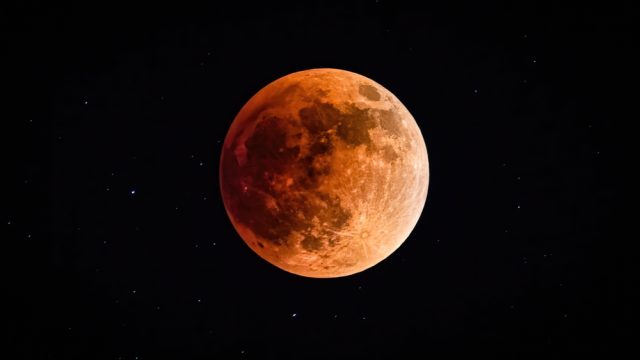
There’s something truly spectacular about being able to gaze up into the sky without a telescope and watch something magnificent happening. But unlike meteor showers where patience and long stretches of waiting are requirements, eclipses provide a perfectly concise way to experience an awe-inspiring event on a set schedule.
Of course, the trade-off is that these solar and lunar events aren’t annual like the Geminids or Perseids, making it all the more important to make the effort to get outside and witness them for yourself. Fortunately, you’ll be able to experience a rare blood moon eclipse tonight using nothing more than your own eyes.
RELATED: 6 Stargazing Secrets, According to Astronomy Experts.
A lunar eclipse will turn the moon red tonight.
In the early morning hours of March 3, 2026, U.S. residents can witness a very unique spectacle when our closest orbiting body will change color. The natural phenomenon occurs as part of a full lunar eclipse, which is when the Earth passes between the sun and the moon (during a full phase) and casts its shadow upon the lunar surface, according to NASA.
While eclipses do darken the moon, they can also cause a unique color-changing effect that results in a “blood moon.” This dramatic shift from brilliant white to dark red and burnt orange is the result of partial light reaching the moon’s surface after passing through the Earth’s atmosphere.
Quite beautifully, NASA refers to this situation: “As if all of the world’s sunrises and sunsets are projected onto the moon” to be shared by millions of people back on Earth at the same time.
While total solar eclipses are exceedingly rare and are only visible in most areas once every 375 years, lunar eclipses are relatively more common and occur about once every 2.5 years, The Washington Post reports. However, the timing of tonight’s event lines up well for viewers within North America, Central America, Australia, and Asia, making it a spectacle available to millions around the globe.
When does the blood moon lunar eclipse start?
Depending on where you live, you may have to stay up well past your bedtime (or wake up well before your alarm) to get the full “blood moon” experience.
According to NASA, the penumbral eclipse kicks off at 3:44 a.m. EST (or 12:44 a.m. PST), which is when the moon will begin to dim. A little over an hour later at 4:40 a.m. EST (1:50 a.m. PST), the partial eclipse will start, bringing a dark shadow to the moon’s surface.
Totality will finally kick off 6:04 a.m. EST (3:04 a.m PST), when the moon is entirely in the Earth’s umbra (or shadow). By now, it will appear as a stunning dark red or orange hue in the night sky for 58 minutes until totality ends at 7:03 a.m. EST (4:03 a.m. PST) and the process begins again in reverse, according to NASA. The eclipse will officially end at 9:23 a.m. EST (6:23 a.m. PST).
Those on the East Coast will be in the strange position of watching totality occur as the moon slips below the horizon at sunrise around 7 a.m. However, this will also create a rare event known as selenelion, where both the rising sun and the blood red full moon will be visible at the same time.
If you don’t want to miss this unique sight, try to find a high-up location with a very clear view of the eastern and western horizons.
RELATED: The 10 Best Destinations for Stargazing in the U.S.
What do I need to watch the blood moon lunar eclipse?
Unlike a total solar eclipse, which requires special protective glasses to avoid damaging the eyes, all you need to see a lunar eclipse is the right timing and clear local weather conditions to view it.
Of course, the moon will be just as large and visible as it normally is in the night sky, meaning you won’t need any instruments or aids to see things clearly. However, grabbing a decent pair of binoculars or setting up a telescope can also get you an even better view.
As with any astronomical event, it’s best to be away from cities and other sources of light pollution to get the best effect. Just be sure to keep those chilly nighttime March temperatures in mind and dress warmly (and maybe bring along a thick blanket) when you’re planning your outside time.