Is Your Face Always Sweaty? This Could Be Why—And What to Do About It

Many of us wish summer could last forever. Yet for people who are prone to excessive sweating, summer is a fraught time marked by discomfort and embarrassment. A sweaty face, in particular, can come as an especially unwelcome side effect of the season. Now, experts are warning that excessive facial sweating should not be dismissed as a normal response to rising temperatures—but instead should be recognized as the medical condition it is, and treated with appropriate care. Read on to learn what could be causing your excessively sweaty face, and to find out what you can do about it.
RELATED: The 5 Best Colors to Wear If You Sweat a Lot, Experts Say.
Excessive facial sweating is known as hyperhidrosis.
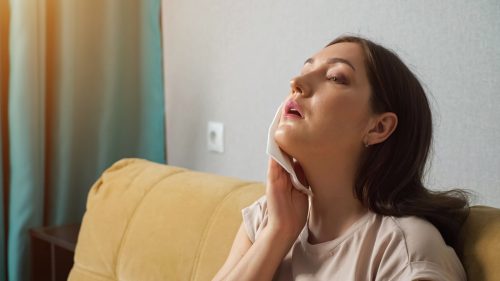
If your face sweats regularly and excessively, you could be suffering from hyperhidrosis, a condition that most often causes irregular sweating from the face, armpits, feet, or the palms of the hands. It can be especially noticeable in the face and scalp, an area of the body with a high concentration of sweat glands.
People with this condition (2 to 5 percent of the population) sweat four to five times more than the average person, and their sweating often occurs in the absence of normal stimuli—meaning even without added heat or humidity, symptoms persist. Right now, up to 365 million people across the globe are believed to have hyperhidrosis.
Though people with hyperhidrosis may experience facial sweating at any time, there are certain circumstances that make it more likely to occur. Common triggers include humid or hot weather, eating spicy foods, and even mild exercise.
Feeling stressed, anxious, or afraid can also increase your sweat levels, according to a 2009 study.
RELATED: Suffering From Night Sweats? These Simple and Safe At-Home Remedies Can Help.
An underlying condition or certain medications could be to blame.
Studies have shown that between 30 and 50 percent of people with hyperhidrosis have a family history of the condition. However, it can also be caused by one of several underlying maladies that make it more likely; when this happens, it is known as secondary hyperhidrosis.
Conditions that can lead to excessive sweating include heart disease, stroke, cancer, diabetes, menopause, and spinal cord injury. Sweating can also be a side effect of several medications, including certain kinds of antidepressants.
Certain medications can lead to hyperhidrosis as a side effect as well. The most common is the antidepressant bupropion, commonly branded as Wellbutrin, which causes excessive sweating in one out of every five people taking it.
Other medications that can cause hyperhidrosis include migraine medications and certain over-the-counter pain relievers such as aspirin and ibuprofen. Opioids are also known to cause excessive sweating. People who take medication to treat more serious conditions such as asthma, diabetes, cancer, and Parkinson’s disease have also reported hyperhidrosis as a side effect.
RELATED: 11 Best Sweat-Proof Makeup Items, Beauty Experts Say.
These medications and procedures treat hyperhidrosis.
If your hyperhidrosis is the result of an underlying condition, treating that condition may help the sweating resolve on its own. Otherwise, the following treatments can help:
Prescription antiperspirant
Think antiperspirant is only for your underarms? Think again.
“Some people may find relief from using an over-the-counter antiperspirant or prescription medication specifically designed for the face,” says board-certified dermatologist Allison Leer, MD.
Facial antiperspirants contain aluminum chloride or aluminum chlorohydrate, which shrink and block the pores to prevent sweat from escaping, she explains, though it’s worth noting that these can sometimes agitate sensitive skin.
Anticholinergics
Your doctor may also prescribe an oral medication known as an anticholinergic, which can help minimize sweating throughout the body.
A 2015 study found that oxybutynin, an anticholinergic prescribed under the brand names Oxytrol or Ditropan, is effective in treating hyperhidrosis, as it blocks the acetylcholine receptors on sweat glands.
Botox

“Botox injections are used to significantly decrease the activity of nerves impacting the sweat glands,” says Shawnda Dorantes, APRN, FNP-C, nurse practitioner and founder of Beauty Lounge Medical Spa. “Sometimes, several treatments are necessary for the injections to begin working. Fortunately, the injections can help with face sweat symptoms for up to 12 months.”
Of course, when you use Botox for sweat, there will also be other side effects, such as paralysis of the forehead (a good thing or a bad thing, depending on your preference!).
Mental health medications
Because the sweat glands in the face, scalp, hands, feet, and armpits are often activated by emotional responses such as stress and anxiety, certain mental health medications may help resolve the problem. Beta blockers, which work by lessening the effects of adrenaline and lowering blood pressure, may help reduce the physical symptoms of anxiety, including excessive sweating.
Lontophoresis
Another treatment option is lontophoresis, a procedure in which a doctor runs a low-level electrical current through the body while the patient is submerged under water. However, experts say this is more effective for those with sweating in the hands, feet, and armpits, rather than the face.
Surgery
In more extreme cases, your doctor may also recommend surgery to remove sweat glands or block the nerves connected to your sweat glands.
Natural remedies
If you’re not ready to try clinical intervention just yet, there may be ways to improve your symptoms at home.
Bathing regularly, applying antiperspirant frequently, and using unscented face powder to absorb excess moisture can all help reduce your sweat. Additionally, avoiding hot and humid weather, limiting your intake of spicy foods and caffeine, and drinking plenty of water may improve some of your symptoms.
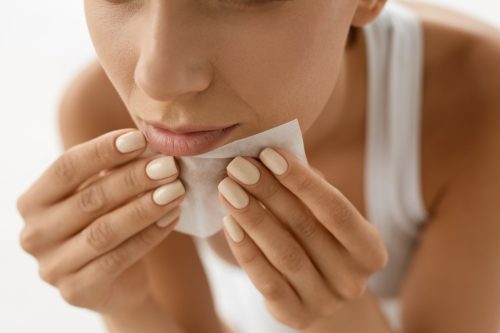
Professional makeup artist Mary Winkenwerder suggests carrying around rice paper with you.
“When you feel a major glow coming on, pull out a single sheet of rice paper and gently blot the area with a press and roll motion,” she suggests. If you’re blemish-free, you can use one sheet of paper on the entire face. However, if you have a pimple or two, “use more than one sheet per face zone to eliminate the spread of the breakouts,” Winkenwerder adds.
Speak with your doctor to determine whether your at-home remedies will suffice or if clinical treatment is necessary.