Getting COVID Could Age Your Body 5 Years, Shocking Research Finds

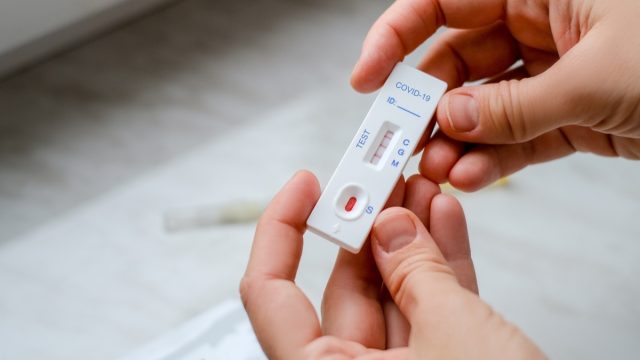
Five-and-a-half years after the COVID-19 pandemic came roaring into the U.S., scientists are making significant breakthroughs in understanding the long-term implications of the virus. Most recently, researchers shared that they believe they’ve identified the first “quantifiable” biomarker of long COVID. This could transform diagnosis and treatment for the condition. And now, another team of researchers announced a discovery that a COVID infection could actually age your blood vessels up to five years—especially for women who’ve gotten sick.
RELATED: Scientists Find Shocking Link Between COVID and Alzheimer’s.
What happens when blood vessels “age?”
As a 2006 study published in the Postgraduate Medical Journal explains, the aging of blood vessels is known as vascular aging.
When this happens, the walls of the arteries (the blood vessels that carry blood from the heart to the rest of the body) become stiffer and less flexible, which makes it harder for blood to flow. This, in turn, increases the risk for cardiovascular disease (including heart attack and stroke), high blood pressure, diabetes, or kidney failure.
What’s the connection between COVID and vascular aging?
A new study published in the European Heart Journal concluded that a COVID infection, particularly in women, may lead to blood vessels aging around five years.
To arrive at their findings, the researchers analyzed the health data of 2,390 people from 16 different countries who were asked to participate between September 2020 and February 2022. They were divided into four groups:
- Never had COVID
- Had COVID but were not hospitalized
- Had COVID and were hospitalized generally
- Had COVID and were hospitalized in an intensive care unit (ICU)
The researchers then assessed each participant’s vascular age six and 12 months after a COVID infection. As the press release explains, they did this by using a device “that measures how quickly a wave of blood pressure travels between the carotid artery (in the neck) and femoral arteries (in the legs), a measure called carotid-femoral pulse wave velocity (PWV). The higher this measurement, the stiffer the blood vessels and the higher the vascular age of a person.”
After adjusting for demographic and health factors, the team concluded the following:
- Women with mild COVID cases had a PWV increase of 0.55 meters per second
- Women who were hospitalized with COVID had a PWV increase of 0.60 meters per second
- Women who were admitted to the ICU with COVID had a PWV increase of 1.09 meters per second
To put this all in perspective, the researchers explain that a PWV increase of around 0.5 meters per second is “clinically relevant” and equivalent to aging around five years. In a 60-year-old woman, this increases the risk for cardiovascular disease by 3 percent.
It’s worth noting that vascular aging was less pronounced in those who had been vaccinated against COVID.
RELATED: These Common Meds May Be Helping COVID Spread in Your Body, Scientists Say.
How does COVID age your blood vessels?
As for how the COVID virus ages your blood vessels, the researchers have some theories.
“The Covid-19 virus acts on specific receptors in the body, called the angiotensin-converting enzyme 2 receptors, that are present on the lining of the blood vessels,” explains lead study author Rosa Maria Bruno, MD, PhD, a professor at the Université Paris Cité, France. “The virus uses these receptors to enter and infect cells. This may result in vascular dysfunction and accelerated vascular ageing. Our body’s inflammation and immune responses, which defend against infections, may be also involved.”
Bruno also addresses the fact that women experienced more significant vascular aging: “Women mount a more rapid and robust immune response, which can protect them from infection. However, this same response can also increase damage to blood vessels after the initial infection.”
She and her team will continue monitoring the study participants to better understand how their vascular aging progresses over the coming years.
“Vascular ageing is easy to measure and can be addressed with widely available treatments, such as lifestyle changes, blood pressure-lowering and cholesterol-lowering drugs,” Bruno concludes. “For people with accelerated vascular ageing, it is important to do whatever possible to reduce the risk of heart attacks and strokes.”