See 150 Shooting Stars Per Hour With This Weekend’s Geminid Meteor Shower

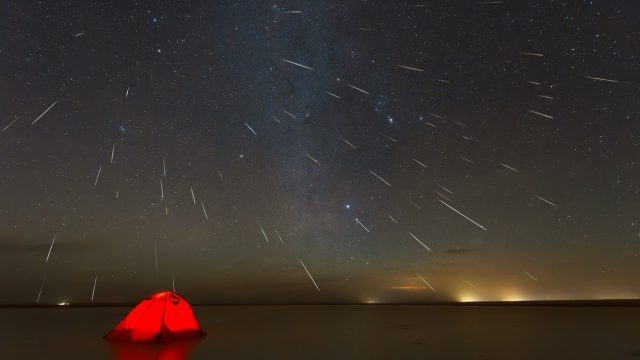
Even though it’s bitterly cold this time of year, there are still plenty of great reasons to spend some time outdoors gazing upwards. Just a few months ago, the Orionid meteor shower put on a dazzling nighttime display, thanks to nearly perfect conditions that set it up for ideal viewing. But things are getting even better this weekend for amateur astronomers and casual stargazers alike: The Geminid meteor shower is making its annual return in what could be the best celestial show of the year.
RELATED: 8 Amazing Things You Can See in the Night Sky Without a Telescope.
When is the Geminid meteor shower in 2025?
The Geminids officially kicked off back on Dec. 4, but things are about to get a lot more exciting. The meteor shower will soon reach its peak on the evening of Dec. 13 into the morning hours of Dec. 14, according to Space.com.
Fortunately, unlike some other showers, you won’t have to stay up too late to catch a decent show. That’s because the shower’s “radiant” point—or the area of the sky where most of the meteors appear to originate—will already be above the horizon as early as 9 p.m.
However, viewing conditions will continue to improve as the radiant rises higher in the sky, reaching an overhead point around 2 a.m. local time. Still, by about midnight, viewers could see anywhere from 120 to 150 meteors per hour, Space.com reports.
And since the moon will be in a waning crescent phase of just 27 percent illumination on the night of the Geminids, and won’t even begin to rise until 2 a.m., there will be very little light pollution to dim the main event.
The “Gems” are known to put on a memorable show.
It’s a bit of cruel irony given the weather, but astronomers have long touted the Geminids (also known as “the Gems” among experts) as nothing short of a must-see event. In fact, NASA calls them “one of the best and most reliable annual meteor showers.”
The Geminids are also unique based on where they come from. Unlike many other meteor showers that originate from the debris left behind by passing comets, the “Gems” are created by the trail of dust and rocks from the asteroid 3200 Phaethon that orbits the sun once every 1.4 years, per NASA.
Because these particles are also denser than typical cometary meteorite material, they can appear differently when they streak across the sky. They typically take longer to burn up in the atmosphere, meaning they tend to create longer trails, especially earlier in the evening, before they move higher in the sky.
Most appear yellow or white in color, but they can also look orange, blue, red, and green, per Space.com.
RELATED: 4 U.S. Regions Where Winters Are Getting Shorter the Fastest.
Here are some other helpful stargazing tips.
As with any meteor shower, your best chance of catching a good show is to get out away from cities or towns where light pollution can spoil the sights. Ideally, wherever you choose to watch will also have a decent view of as much of the sky as possible, without trees, buildings, or mountains blocking much of the horizon, according to Space.com.
But of course, the most important thing to remember is that you’re setting out to watch a meteor shower in mid-December. It’s absolutely essential to dress warmly and bring along heavy blankets, a sleeping bag, or even a battery-powered heating pad to stay comfortable.
Once you arrive, remember you’ll need 20 minutes or so for your eyes to adjust to the lighting conditions, so try to avoid looking at your phone while you wait.
Hopefully, local weather conditions will cooperate, and cloud coverage or rain won’t spoil the best night of the year for meteor watching. But if you somehow miss the evening of the 13th, you still might be able to catch some of the lingering Geminids on the evening of Dec. 14 to Dec. 15. While there will only be roughly a quarter as many meteors, the debris that hits the Earth’s atmosphere after the peak tends to be much larger, making them much brighter, according to Space.com.