21 Things Grandparents Should Never Say to Their Grandkids

The relationship between grandparents and their grandchildren can be an undeniably special one. After all, grandparents get to enjoy all the fun of watching their little ones grow up without worrying about the less enjoyable parts of parenting, like the nightly wake-ups, the toddler (and teen) tantrums, and the ever-growing cost of college. However, at the end of the day, without the day-to-day dependency that typically exists in a parent-child relationship, a kid’s bond with their grandparents is a more precarious one, meaning even one seemingly small misstep can potentially cause irreparable harm. If you want to stay on the right side of your grandkids—and their parents—today and in the future, read on to learn the things grandparents should never say to their grandchildren, according to mental health professionals.
1
“It’s just a little white lie.”

While sneaking your grandchild an extra cookie or telling them not to let their parents know about the hours of TV you let them watch may not seem like a big deal, encouraging them to lie about it definitely is. In doing so, you’re showing your grandkids that it’s fine to massage the truth in other areas of life, too. After all, “if they are happy to lie about small things, do you really know what other truths they might be happy to cover up?” asks Tampa-based relationship therapist Megan Harrison.
2
“It’s not that big of a deal.”

Your preschool-aged grandchild’s fight with a friend or a middle schooler’s skinned knee may not seem like the end of the world to you, but this type of language will invariably cause bigger problems than it aims to solve. “This statement deeply invalidates another person’s feelings and perspective. It also shames them for feeling this way,” explains Harrison. She notes that this statement can add embarrassment to an already difficult situation, but rarely helps diffuse it.
3
“You love grandma/grandpa the most, right?”

Even if you think you’re simply remarking on the closeness of your relationship with your grandchild, telling them that they love one of you more is always a bad idea. “It makes the child feel the need to prove their love [to the grandparent they allegedly love less],” explains licensed therapist and parenting expert Rose Skeeters, who notes that this may make a child less likely to open up about their feelings in the future.
4
“If you don’t have anything nice to say, don’t say anything at all.”

In theory, it may seem better to teach your grandchild to speak kindly to and about other people. But in reality, this message may get lost in translation. “This advice asks a child to be inauthentic and to suppress their opinions,” explains Houston-based licensed professional counselor Natalie Mica. “It can also leave them in danger by causing them to not disclose important matters that may need adult attention.”
5
“Because I said so.”

You may want your word to go unquestioned, but telling your grandchild this is never going to yield the results you want. “This devalues a child’s curiosity and leaves them feeling dismissed and unimportant,” explains Mica.
6
“I love you, but I don’t like you right now.”
This phrase may not seem like such a devastating blow, but make no mistake: It absolutely is. “When they hear that they are loved unconditionally but that they might not be likable people, we can really do a number on children’s self-esteem,” explains therapist Heather Z. Lyons, PhD, owner of the Baltimore Therapy Group.
Instead of delivering this kind of statement, “this might be an opportunity to explain that we all make mistakes from time to time and we can help empower [them] to help remedy those mistakes.”
7
“Your sibling can do it—why can’t you?”

It can be difficult to avoid drawing comparisons between grandkids, but doing so will only cause serious—and possibly irreparable—problems. “Each child will require a different approach,” explains Lyons. “Comparison overlooks that uniqueness and is a set-up for sibling rivalry and low self-esteem.”
8
“Your friends don’t do that.”

Comparing siblings can be damaging, but comparing your grandchildren to their friends can be just as insidious a behavior. Uttering this phrase is simply “using different variations of peer pressure,” explains Mica. By comparing a child to their peers, you’re “teaching them to gauge themselves by external [factors] rather than by their own internal values, interests, and efforts.”
9
“You’re lucky—I had it way worse.”

Just because you had a difficult childhood—whether that included allegedly walking 12 miles through the snow to school or harsh discipline—doesn’t mean your grandkids should feel lucky for having things easier. Saying this to your grandchildren when they’re upset about something “basically tells [them] that their experience and their perceptions are wrong, and actually makes them question their own sanity,” explains psychotherapist Lisa S. Larsen, PsyD.
10
“Would a treat make it better?”

While grandparents are often a bit more indulgent when it comes to toys and sweets than parents are, trying to excuse a mistake or make up for a disappointment with a present can cause major problems. In some cases, family members attempt to “minimize the impact of what they did by buying the child something like a treat item or a toy” after they’ve been disciplined, says Larsen. “This does not erase what happened… It says, ‘People can treat you poorly, but if they buy you something it makes it all right.’”
11
“Your parent was such a bad kid.”

Your own kids may have wreaked havoc in their younger days, but telling your grandchildren about it isn’t going to repair the past—and it could make those relationships far more contentious in the future. “Grandparents need to respect their role,” says Larsen. “If they say disrespectful things about their own children to their grandchildren, the grandchildren may come to disrespect their own parents and it ruptures the relationship between the grandchildren and their parents.”
12
“Your parents aren’t always right.”

You may not agree with the way your children are raising their own brood, but telling your grandkids that their parents are wrong is never the solution. This “undermines [the parent] and may cause the child to become disrespectful toward [them],” explains Danni Zhang, principal psychologist and founder of New Vision Psychology. If you want your grandchild’s parent to change their behavior, that’s something to take up with them, not with your grandkid.
13
“You’re my favorite.”

While you may have a grandchild who you connect with more than the others, telling them as much—even in a joking manner—will only cause problems in the long run. Telling your grandchild this “creates a sense of entitlement and may cause behavioral problems in social situations,” explains Zhang. Worse yet, it can cause division between siblings or cousins, making those who haven’t earned similar praise feel like you don’t love them as much.
14
“If you don’t listen, you won’t be my favorite anymore.”
Sure, it may be frustrating to feel like everything you’re saying to your grandchild is being ignored, but you should never make this kind of threat. In doing so, “the child develops insecurity in their relationships,” says Zhang, who adds that statements like this don’t actually teach them an appropriate behavioral alternative.
15
“Did you get a good grade?”

While grandparents may be nearly as invested in their grandkids’ academic success as the child’s parents are, focusing on their grades can be damaging in the long run. If you’re asking these questions of your grandkids, you’re “focusing purely on outcomes rather than being interested to learn about your grandchild’s interest in [their] classes and learning,” explains Zhang.
16
“I’m so ashamed.”

Unfortunately, your grandchild’s behavior may not always make you proud, but telling them you’re ashamed of them won’t remedy the situation either. “Shame is the painful feeling that we are inherently wrong or bad and unworthy of love and belonging,” explains Mica. “It is a very powerful and damaging feeling or experience that can affect the whole trajectory of a person’s life.”
17
“You’re a bad kid.”

Even if your grandchild seems determined to destroy everything in their path, there’s never a reason to tell them they’re “bad.” After all, what can a child really say in response to this kind of criticism? “These phrases become internalized and make it harder for a child as they grow up to realize that they can make bad choices without being a bad person,” explains Hayley Roberts, PsyD, a licensed clinical psychologist in Denver, Colorado.
18
“Don’t be stupid.”

If you don’t want your grandkids to go around calling other people names, it’s time to nip phrases like this in the bud. “Never call your grandkids stupid,” says psychotherapist Richard A. Singer, Jr., MA. “Labels and negative statements toward human beings in general can be turned into a self-fulfilling prophecy,” meaning they might just start behaving that way if they already feel like the adults in their life expect them to.
19
“You’re too sensitive.”
Since when is being sensitive such a bad thing anyway? “This remark invalidates the child’s emotions and may lead them to hide their emotions,” explains Mica. She notes that saying this to your grandchild can lead to relationship issues later on.
20
“You should be more like ____.”
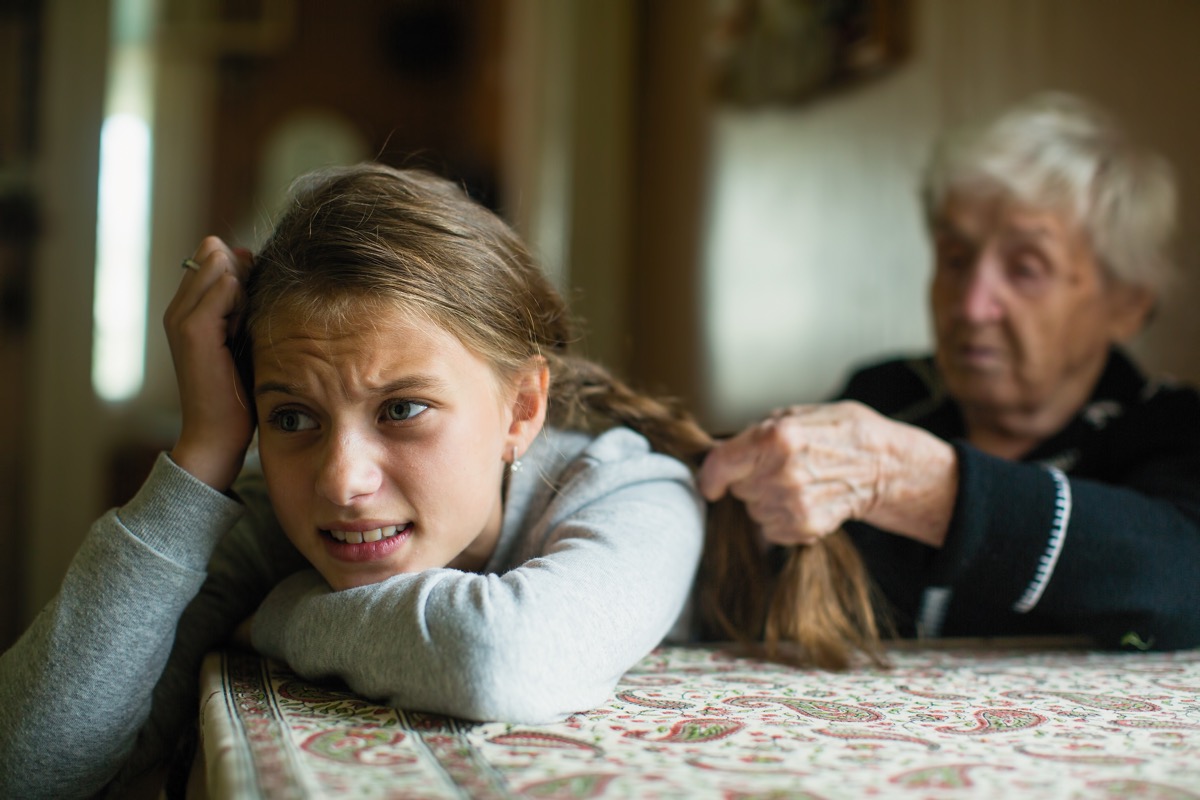
While you may know another child who seems like an absolute angel compared to your own grandkids, letting them know that you’re making these mental comparisons will only cause harm. “Comparing sends the message that a child isn’t good enough, which can lead to feelings of inadequacy, shame, and doubt,” explains therapist Emily Guarnotta, PsyD, founder of The Mindful Mommy.
21
Anything you don’t want them to repeat.

Even if it seems like it will be ages before your grandchild is repeating things—or talking at all—it’s wise to err on the side of caution in terms of what you say in their presence.
“You should expect that anything you say or do… can and will be repeated at some point in the future,” explains Guarnotta. “Even children that are preverbal are tuning into what they hear, so it’s important to start monitoring your communication early on.”